
OpenAI Navier-Stokes: 5 Amazing Facts Behind the Math Breakthrough
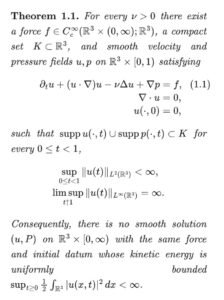
OpenAI has claimed a remarkable advance on the Navier-Stokes problem, one of mathematics’ famous Millennium Prize challenges. But there is an important distinction: the reported AI-generated proof has not yet been publicly verified as an accepted solution. That makes the breakthrough both potentially historic and still highly contested.
Quick Answer
OpenAI says an internal AI system produced a proof addressing the three-dimensional Navier-Stokes problem, which carries a $1 million Millennium Prize. The reported work concerns finite-time singularity or “blowup.” However, the proof has not been publicly established as an accepted Clay Mathematics Institute solution, so the problem’s official status remains unresolved.
What Is the Current OpenAI Navier-Stokes Status?
The current situation is a major claim, not yet a formally accepted mathematical solution. Reports say OpenAI used a large-scale AI effort to extend recent mathematical work toward the full Navier-Stokes equations. The proof reportedly spans roughly 100–165 pages, depending on the account, but public mathematical scrutiny is still the crucial next step.
5 Key Developments
- A $1 million problem is at the center — Navier-Stokes is one of seven Clay Millennium Prize Problems.
- AI reportedly found a blowup result — The claimed work concerns whether smooth 3D fluid equations can develop a finite-time singularity.
- The effort used enormous computing power — Reports describe thousands of AI agents and substantial compute resources.
- Credit has become controversial — Mathematicians Tristan Buckmaster and Levent Alpöge have raised questions about research credit and the relationship between their work and OpenAI’s result. OpenAI has disputed allegations of misconduct.
- Verification is the real test — A claim does not become an accepted Millennium Prize solution until mathematicians can examine and validate the proof.
For more free AI tools, visit now: https://freeaitools4u.com/
Did OpenAI Actually Solve the Navier-Stokes Problem?
Not officially yet. OpenAI’s claim could eventually prove historic, but independent verification is essential. The Clay problem asks whether smooth three-dimensional incompressible Navier-Stokes solutions remain smooth forever or can break down in finite time.
Why Is Navier-Stokes So Difficult?
The challenge is proving what happens to fluid motion in three dimensions under all allowed conditions. Scientists can solve and simulate many practical fluid-flow problems, but the mathematical question of guaranteed global smoothness remains extraordinarily difficult.
What Happens Next?
The next major step is publication and independent mathematical scrutiny. If experts verify the complete argument against the official Clay formulation, the significance would extend far beyond OpenAI: it could demonstrate a new role for AI in producing genuinely novel mathematical proofs.
Final Take
The OpenAI Navier-Stokes story is potentially historic, but “claimed breakthrough” is more accurate than “problem officially solved” right now. The proof’s verification will determine whether this becomes one of AI’s greatest scientific achievements.
Read More:- China: America’s Big Battery Challenge
FAQs
1. What is the Navier-Stokes problem?
It asks whether smooth 3D incompressible fluid-flow solutions always remain smooth or can develop a finite-time breakdown.
2. How much is the Navier-Stokes prize worth?
The Clay Mathematics Institute offers $1 million for an accepted solution to each Millennium Prize Problem.
3. Did AI solve Navier-Stokes?
OpenAI claims its internal AI system produced a solution, but independent mathematical verification remains necessary.
4. What is a Navier-Stokes singularity?
It refers to a possible finite-time breakdown where quantities in the mathematical solution become unbounded.
5. Why is the OpenAI claim controversial?
The controversy includes questions about research credit, related mathematicians’ work and how the AI-generated result was developed.