
AI Detectors Are Lying to Millions? Here’s What You Need to Know
Artificial intelligence has completely transformed content creation.
From blog posts and marketing copy to emails and research articles, AI writing tools are now used by businesses, students, marketers, and content creators worldwide.
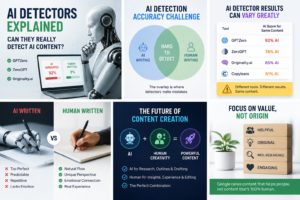
At the same time, a new industry has emerged—AI content detection.
Tools like GPTZero, ZeroGPT, Originality.ai, and other AI detectors claim they can determine whether content was written by a human or generated by artificial intelligence.
But a critical question remains:
Can AI detectors actually detect AI-generated content with high accuracy?
The answer is more complicated than most people realize.
What Is GPTZero?
GPTZero is one of the most widely recognized AI detection tools available today.
It is commonly used by:
- Educational institutions
- Universities
- Recruiters
- Publishers
- Marketing agencies
- Content verification teams
The platform analyzes text patterns and uses machine learning algorithms to estimate whether content was likely written by AI or a human author.
As AI-generated content becomes more common, tools like GPTZero have gained significant popularity.
However, popularity does not always guarantee accuracy.
How AI Detectors Actually Work
Most AI detection tools rely on statistical analysis rather than direct identification.
They typically evaluate factors such as:
Predictability
AI-generated text often follows predictable language patterns.
Sentence Structure
Detection systems analyze how sentences are constructed and connected.
Probability Scores
AI models generate text based on probability distributions, which detectors attempt to recognize.
Writing Consistency
Detectors look for repetitive structures, unusual fluency, and other characteristics associated with machine-generated content.
While these methods may sound advanced, they come with important limitations.
The Biggest Problem With AI Detection
The core issue facing modern AI detectors is simple:
Human writing is becoming more AI-like.
And AI writing is becoming more human-like.
This creates significant overlap between the two.
As a result, many detection tools struggle to consistently distinguish between human-created and AI-assisted content.
Common outcomes include:
- Human-written content flagged as AI
- AI-generated content classified as human
- Contradictory results between different detectors
- Businesses making decisions based on unreliable scores
This problem continues to grow as AI writing models become more sophisticated.
Why AI Detection Accuracy Is Declining
Artificial intelligence is evolving faster than detection technology.
Modern AI systems can now:
- Mimic conversational writing styles
- Incorporate emotional language
- Create natural storytelling patterns
- Introduce sentence variation
- Simulate personal experiences
- Produce highly human-like content
As a result, identifying AI-generated text has become increasingly difficult.
A useful comparison is facial recognition.
Detecting early AI-generated text was relatively straightforward.
Detecting advanced AI-generated content today is far more challenging because the differences are becoming increasingly subtle.
The False Positive Problem
One of the biggest concerns surrounding AI detectors is false positives.
A false positive occurs when human-written content is incorrectly labeled as AI-generated.
This issue can have serious consequences.
For example:
Students
Original assignments may be incorrectly flagged.
Job Applicants
Writing samples could be questioned despite being authentic.
Content Creators
Articles may receive inaccurate AI scores despite extensive human editing.
Businesses
Publishing decisions may rely on unreliable detection results.
Because no detector can verify authorship with complete certainty, false positives remain a major challenge across the industry.
Why Businesses Should Focus on Content Quality Instead
Many organizations ask the wrong question.
Instead of asking:
❌ Was this written by AI?
A better question is:
✅ Does this content provide value?
Search engines, readers, and customers care about usefulness, accuracy, and relevance.
High-quality content succeeds because it solves problems and answers questions—not because of how it was drafted.
This shift in thinking is becoming increasingly important as AI-assisted writing becomes part of standard content workflows.
The Future of Content Creation: Human + AI
The future of content creation is not a competition between humans and artificial intelligence.
The most successful creators are combining both.
AI can assist with:
- Topic research
- Content outlines
- Draft generation
- SEO optimization
- Content scaling
Humans contribute:
- Expertise
- Industry knowledge
- Real-world experience
- Critical thinking
- Unique perspectives
This hybrid approach often produces stronger results than relying entirely on either humans or AI alone.
How to Create Content That Ranks in Google
If your goal is organic traffic and long-term search visibility, focus on quality rather than detection scores.
1. Share Original Experience
Use personal examples, case studies, and firsthand insights whenever possible.
2. Match Search Intent
Understand exactly what users are searching for and provide clear answers.
3. Build Strong SEO Structure
Use:
- H2 and H3 headings
- FAQ sections
- Internal linking
- Semantic keywords
- Readable formatting
4. Edit Every Draft
Whether content is written by humans or AI, professional editing improves quality and trustworthiness.
5. Demonstrate EEAT
Google values:
- Experience
- Expertise
- Authoritativeness
- Trustworthiness
Strong EEAT signals help content perform better in search results.
Read More :- GTA 6 Pre-Orders Spark Wall Street Frenzy: Can AI Predict the Biggest Entertainment Launch Ever?
Frequently Asked Questions
Is GPTZero accurate?
GPTZero can identify patterns associated with AI-generated writing, but it cannot guarantee perfect accuracy. Results should be treated as indicators rather than definitive proof.
Can AI detectors identify GPT-5 content?
Sometimes. However, advanced AI-generated content is increasingly difficult to distinguish from human writing.
Does Google penalize AI-generated content?
Google focuses on content quality, usefulness, and value rather than whether content was created using AI assistance.
Can human-written content be flagged as AI?
Yes. False positives remain one of the biggest limitations of current AI detection technology.
Which AI detector is the most accurate?
No AI detector currently offers 100% accuracy. Different tools often produce different results when analyzing the same content.
Final Verdict
AI detection tools have become a rapidly growing industry.
However, one reality remains clear:
The smarter AI becomes, the harder accurate detection gets.
While tools like GPTZero and ZeroGPT can identify certain writing patterns, they cannot reliably determine authorship in every situation.
For content creators, marketers, businesses, and publishers, the better strategy is to focus on creating valuable, trustworthy, and informative content.
At the end of the day, readers don’t care whether content started with AI assistance.
They care whether it solves their problem.
And that’s what truly matters.