
Elon Musk Just Made a $16.8 Billion Move — Here’s What Happens Next
Elon Musk has made another move that could change far more than the future of Tesla or SpaceX.
On August 6, 2026, Tesla and SpaceX confirmed plans to initially invest $16.8 billion in a massive semiconductor project called Terafab in Texas. The facility is being designed to produce advanced chips for artificial intelligence, Tesla’s humanoid robots and vehicles, and SpaceX’s growing computing ambitions.
And that is only one part of the story.
At the same time, SpaceX is pouring billions into AI infrastructure, preparing another major Starship test and dealing with fresh investor questions following its first earnings report as a public company.
So, what is Elon Musk actually building?
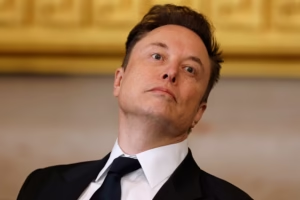
Elon Musk’s $16.8 Billion Terafab Bet
Terafab may be one of the most important pieces of Musk’s technology strategy right now.
The planned Texas complex is expected to cover roughly 100 million square feet and bring chip manufacturing, packaging and testing together in one location. The project is expected to create at least 3,000 jobs, while future expansion could push the overall investment dramatically higher.
The reason is simple: Musk’s companies need enormous amounts of computing power.
Tesla wants AI systems for autonomous vehicles and Optimus humanoid robots. SpaceX is developing AI computing infrastructure and satellite technology. Producing more of the required chips internally could give Musk greater control over one of the most important parts of the AI supply chain.
This isn’t just another factory announcement.
It is an attempt to build the hardware underneath Musk’s broader AI vision.
The AI Spending Is Getting Massive
SpaceX’s latest financial results show just how aggressively Musk is pursuing that vision.
For the quarter ending June 30, SpaceX reported revenue of about $7.8 billion, nearly double the same period a year earlier. Starlink remained a major contributor, while the company’s AI business also grew sharply.
But there is another number that grabbed investors’ attention.
SpaceX spent approximately $15.8 billion on AI-related capital expenditure during the quarter, contributing to total quarterly capital spending of around $18.4 billion. The company has also signed additional large cloud-computing contracts.
That creates a fascinating question:
Can Musk turn massive AI spending into an equally massive business?
SpaceX executives argue that the economics of its new computing capacity are improving quickly. Investors, however, are watching closely because such an aggressive expansion requires enormous amounts of capital.
That tension could become one of the biggest Elon Musk stories of the rest of 2026.
Read More:- Jorge Messi Dies at 68: Lionel Messi’s Father and Agent Passes Away
Tesla and SpaceX Could Become Even More Connected
There is another reason Terafab is attracting attention.
Tesla and SpaceX are already collaborating in several areas, and Musk recently refused to completely close the door on the possibility of combining the two companies.
During Tesla’s July earnings call, Musk pointed to increasing overlap between Tesla and SpaceX while saying that any discussion about actually combining the companies would have to follow the proper corporate process.
That does not mean a Tesla-SpaceX merger has been confirmed.
But the speculation is becoming harder to ignore.
Both businesses are increasingly connected through AI, computing, advanced hardware and robotics. Terafab could potentially become another piece of that shared technology ecosystem.
For Musk, the bigger strategy may be less about running isolated companies and more about connecting them.
Starship Could Be the Next Big Test
While the AI story is developing on Earth, SpaceX is preparing for another major test in space.
SpaceX is targeting another Starship flight as early as the end of August 2026, pending regulatory approval.
The planned mission could be particularly important because SpaceX wants to attempt something it has not previously achieved with the upper stage: bringing the spacecraft back for a landing catch using the giant mechanical arms on the launch tower.
The mission is also expected to carry the first upgraded Starlink V3 satellites, which are designed to provide substantially greater broadband capacity than earlier generations.
If SpaceX successfully demonstrates more reliable recovery, the implications could be huge.
Reusable rockets are central to Musk’s long-term plan to dramatically increase launch frequency and expand Starlink.
Why This Could Be Musk’s Biggest Strategy Yet
Put all these developments together and a bigger picture starts to appear.
Tesla is moving deeper into AI and robotics.
SpaceX is expanding Starlink while investing heavily in AI computing.
Terafab is designed to provide advanced chips for those ambitions.
Starship could eventually provide the transportation infrastructure needed to expand SpaceX’s satellite and space operations.
That means Musk is increasingly building an ecosystem where chips, AI, robots, satellites, rockets and computing infrastructure support one another.
Of course, none of this guarantees success.
The projects require enormous investment, complicated engineering and regulatory approvals. SpaceX’s recent stock volatility also shows that investors are becoming more demanding about how quickly Musk’s ambitious plans can translate into financial returns.
But if even a large portion of this strategy works, Musk could end up controlling pieces of a technology ecosystem that reaches far beyond electric cars and rockets.
What Happens Next for Elon Musk?
The next few months could reveal whether Musk’s latest strategy is beginning to work or simply becoming more expensive.
The key things to watch are Terafab’s development, SpaceX’s AI spending, Starship’s next flight, Starlink’s expansion and any new developments involving Tesla and SpaceX.
For now, one thing is clear:
Elon Musk isn’t slowing down. He’s building deeper connections between AI, robotics, chips and space—and the $16.8 billion Terafab project may be one of the clearest signs yet of where he wants to go next.
FAQs
1. What is Elon Musk’s $16.8 billion project?
It is Terafab, a planned semiconductor manufacturing complex in Texas being developed by Tesla and SpaceX. The facility is intended to produce advanced chips for AI and other applications across Musk’s businesses.
2. Is Elon Musk merging Tesla and SpaceX?
No confirmed merger has been announced. Musk has acknowledged increasing cooperation and overlap between the companies, which has kept merger speculation alive.
3. Why is Elon Musk investing so much in AI?
AI is becoming central to Tesla’s autonomous-driving and robotics ambitions as well as SpaceX’s computing strategy. SpaceX’s recent results showed very large investments in AI infrastructure.
4. When could the next Starship launch happen?
SpaceX is targeting another Starship test as early as the end of August 2026, subject to regulatory approval. The mission could include an attempt to catch the upper stage back at the launch tower.